
In the quick-skim version of American colonial history, our country began in earnest when the Pilgrims came over on the Mayflower in 1620, seeking religious freedom. There was an inconsequential Lost Colony before that, Pocahontas saved John Smith, and First Nations people had been here for centuries. Nonetheless, the Pilgrims are the heroes of the story. They had a lovely Thanksgiving celebration with the Indians and mostly got along. (Except later we learned of those smallpox blankets…)
The new origin story starts in 1619—even before the Mayflower—and includes the ship White Lion, which carried “twenty and odd” enslaved people. I prefer whole-milk stories to skim. I appreciate the increased retellings of the 1619 story, and while all narratives necessarily omit some details, a few of the omissions would promote clearer understanding.
In my manuscript, Stolen Children, my fictionalized character John Clay recounts the story of the Treasurer, a ship he sailed on, including the story of the White Lion. Simplifying the story may lead readers to wonder how slavery advanced if slave ships carried only two dozen people and the first ship traded its entire cargo for food for the crew. It also neglects the tragedy of the many, many thousands of kidnapped people who were taken to Central and South America during the century before that 1619 crossing.
To fully understand the 1619 story of the White Lion, it is important to know that the ships White Lion and Treasurer were both privateers owned by a wealthy Englishman. As described more fully in Stolen Children, one sailed under a Dutch flag and the other under a French flag to provide cover for piracy against Spanish and Portuguese ships. (Portugal was under Spanish control at the time.) England had previously encouraged such piracy because it weakened Spain, their perpetual enemy. Later, England turned a blind eye to the piracy. But in 1619, a treaty forbade such attacks by English ships, hence the cover of the Dutch and French flags.
The Portuguese ship San Juan Bautista had departed Africa, transporting about 350 captives to Mexico for Spain. Some of the captives, who were horribly mistreated, surely died along the way. The ship had unloaded some others, including many children, in Jamaica, and had around 150 captives remaining on board as it neared Vera Cruz. The two English ship captains attacked and boarded the ship; each captain stole some of the captives. They chose as many of the healthiest captives as they could transport, about thirty each.
Scholars have debated exactly how many captives were included in the “20 and odd” on the White Lion, if any were unloaded from the Treasurer, and if any arrived earlier. I imagine John Rolfe would have taken the time to count carefully if he knew we would be debating his words four centuries later. Yet other counts were taken. James Wood, the Treasurer’s navigator, was called to testify before the English High Court of the Admiralty about piratical activities. He swore under oath that “28 or thirty negroes” from the San Juan Bautista were loaded onto the Treasurer. The Treasurer arrived three or four days after the White Lion, and “two or three negroes they caste at Virginia.”[1]
The first American census was taken in March 1620, about seven months after the arrivals. It listed 892 European colonists living in Virginia, including 670 men, 119 women, 39 “serviceable boys,” and 57 children. For non-Europeans, the record included 32 Africans (17 women and 15 men) and 4 Indians described as “Others not Christians in service of the English” and “in ye service of several planters.”[2] The date of this first American census has confused some researchers because it was dated as from “ye beginning of March 1619.” That used the “old style” calendar in which the new year began on March 25.[3] This first census was after the August 1619 arrivals.
The 1624 Muster of Virginia lists “Angelo a Negro woman came in the Treasurer” in the muster of William Pierce, so she was one of the two or three unloaded from the Treasurer before it went to its final destination in Bermuda.
1619 was not the beginning
The 1619 captives aboard the White Lion were not the first people of African descent to set foot on the land that would become the United States of America. According to Henry Louis Gates Jr. and Donald Yacovone’s book, The African Americans: Many Rivers to Cross, which serves as a source for much of this section, a free Black man arrived more than a century before 1619.
In 1513, and again in 1521, Juan Garrido, a Spanish conquistador from West Africa, joined Ponce de Leon in exploring and claiming all of Florida for Spain. In 1613, another free Black man, Jan Rodrigues, became a Dutch trader on Manhattan Island.
By 1444, Portuguese ships were transporting captured Africans to the island of Madeira to cultivate sugar cane. In 1526, Portuguese mariners transported enslaved Africans to Brazil, establishing the trans-Atlantic slave trade.
The Spanish enslaved the indigenous people of Central America to mine for gold. The brutal conditions of slavery, combined with disease, decimated the indigenous population in Mexico. The Spanish began shipping enslaved Africans to replace those enslaved people. In 1570, there were over 20,000 Black Africans in Mexico; Africans had become the largest demographic group. In 1610, there were nearly 9,000 Africans in Havana. The 1614 census in Peru counted 10,000 Africans in Lima.
The first enslaved Africans likely arrived in the land that would become the United States in 1526, at the Spanish settlement of San Miguel de Gualdape, on land which is now in the state of Georgia. When the colony struggled, and the Spanish were driven out by the Gaule Indians, the Africans allied with the Gaules and established a Maroon settlement. (Maroon settlements were communities of Indigenous people and people who escaped slavery.)
Francis Drake brought the first enslaved people to the Roanoke colony in English America around 1585. He delivered 250 enslaved Africans he had captured in Caribbean raids.
England had slaves from Africa prior to the White Lion’s arrival in Jamestown. As happened with those twice-stolen people on the White Lion, the earliest Africans who the English enslaved were seized off Portuguese ships leaving from Cape Verde. Queen Elizabeth (who reigned 1558–1603) demanded that “blackamoors” be driven from England, even though she benefited from her own African servants. Later, during the English Civil Wars, the Earl of Stamford suggested that Royalist soldiers who refused to join Parliament should be sold to Barbary pirates as slaves.
Decades later, in the 1650s, Oliver Cromwell threatened to enslave resisting Irish and Scots, and did send some Irish people to America against their wills. (English children, some orphaned, some captured, had been sent beginning around 1611.)
By 1625, when there were still only two to three dozen captured Africans in Virginia, there were already over 350,000 enslaved Africans in the New World. Brazil had about 50,000 enslaved Africans (and 50,000 Portuguese colonists) in 1620, but this number increased rapidly, with over 6,000 additional Africans arriving each year between 1620 and 1625.
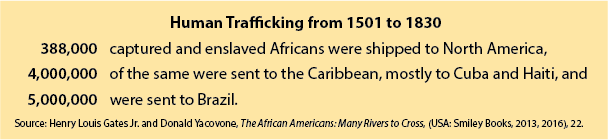
In 1830, there were estimated to be 2.3 million Black people in North America and 2.4 million in the Caribbean. The North American population had increased to about 600 percent of those sent, while the Caribbean population had fallen to only 60 percent of those sent. Survival and reproductive success rates were approximately 10 times higher in North America than in the Caribbean.
While Portuguese explorers spread the enslavement of Africans around the world, slavery existed on a large scale in Africa even before contact with Europeans. Capturing and enslaving was an outcome of war. Why kill when using a captive as labor or for sale was so much more advantageous? Slavery was not, however, considered perpetual or heritable. Captives could hope to be traded back to their people until trade with Europeans removed them far from their homelands.
Those “twenty and odd” (perhaps thirty-two) Angolan captives arrived in Virginia before the reign of Queen Nzinga, but they were joined by many from their ancestral homeland during her four-decade reign beginning in 1624.
Queen Nzinga (1583-1663) ruled the Kingdom of Ndongo, which is present-day Angola. She was an exceptionally strong ruler. Tragically, capturing and enslaving people to sell or give away in diplomatic negotiations was an important aspect of her power. She captured as many of her rivals’ subjects as possible through multiple wars. By 1648, she had turned her capital into a major slave-trading center. Later, after losing a war to the Portuguese, she joined her forces with the Imbangala, brutal mercenary soldiers, to increase her power and enslave more people.[4]
The Rising Tide
While it is devastating to see the rise of slavery in 1600s Virginia, it is also instructive. Although slavery was well established in Central and South America, could it have been stopped in the land that became the United States? What laws, what actions, what attitudes could have turned the tide to reduce this terrible tragedy that still afflicts our nation?
Census estimates show a slow increase for the first few decades following 1619.[5]

In 1640, there were more people of African descent in New York than in Virginia (232 compared with 150). Over the course of a single lifetime, the number of enslaved people in Virginia rose from dozens to thousands.
Two generations later, keeping people enslaved had become so ubiquitous that it may have seemed almost normal. By 1750, the enslaved population of Virginia was over 100,000—more than forty percent of the colony’s population. To the south, South Carolina’s Black population in 1750 (39,000) was over sixty percent of the non-native total population (64,000).[6]

The Royal African Company
In my opinion, the formation of the Royal African Company (RAC) in 1660 should not be overlooked as a cause of the increase in enslaved people in English America. The first ships bringing enslaved Africans to the American colonies captured those captives from Spanish or Portuguese ships. Then the Royal African Company (RAC) was established, and King Charles II granted it a monopoly on English trade with West Africa.
The RAC was formed to pursue gold, but quickly expanded to human cargo in 1663. The Duke of York, James Stuart, brother of the king, was the leading shareholder. (The Duke of York would succeed his brother and become King James II in 1685.) The RAC lost its charter due to financial setbacks, but was succeeded by the more ambitious and successful Royal African Company of England (RACE), which became the leading company in shipping kidnapped Africans to the Americas.
Enslaved people were sometimes branded with DY for Duke of York, or RAC for Royal African Company. In 1672, Charles II granted the company a monopoly over the slave trade in all the British colonies.
Slave Codes
Laws to protect the most vulnerable should be a mark of advanced civilization. Is that debatable? I hope not. I can’t help but think that if our society valued children more, and if early colonial leaders had passed laws to protect the children sent to the colonies to be used as servants, we would have begun with a record of human rights rather than human wrongs.
Indentured servants’ rights were similarly not protected.[7] Over time, Africans who arrived enslaved were not only not protected, but their rights were actively denied, and human wrongs were institutionalized by laws.[8]
The right to liberty is foremost in natural law, which is understood as a system of right or justice common to humans, or as a set of unchanging, unwritten moral principles that seem normal to normal human beings. To deny the right to liberty takes conscious effort.
—
When I visited the Smithsonian National Museum of African American History for the first time in 2016, I was struck, among all the outstanding exhibits, by one display that read:
“As the Chesapeake region began to take shape, ideas of race and class were less defined. Enslaved Africans, European indentured servants, and Native Americans worked alongside one another as they cultivated tobacco. They also intermarried, socialized, ran away, and rebelled together. Fearful of interracial alliances and eager for profits, planters saw slavery as a safer and cheaper option, Africans were ultimately defined as ‘enslaved for life,’ and the concept of whiteness began to develop.”
The concept struck me as profound. Later, I remembered the text as meaning kidnapped Africans were not enslaved because they were Black; they became Black to keep them enslaved. When I returned to the museum a second and a third time, I reread and reevaluated. The new concept in the 1600s was whiteness, rather than being Black. Being White meant those in positions of power, of European descent, could justify their positions as slaveholders, rather than as slaves, because of their whiteness.
To enslave humans, not only were protections for basic human rights not put in place, but laws also needed to be passed to reinforce whiteness, actively deny the humanity of non-white people, and counteract natural law.
The most insidious of the laws was the 1662 act, “Negro women’s children to serve according to the condition of the mother.” Under English common law, a child’s status followed the father—pater familias—so the act treated the descendants of Africans in direct contradiction to what was considered normal practice. The act was intended to enslave even those children whose fathers were free, and typically White. (The law was passed in response to the case of Elizabeth Kay Grinstead.)
This law was particularly devastating because it established chattel slavery in America, in which humans and their offspring could be treated as property. An enslaved Black person became, instead of a labor expense, an interest-bearing asset. Purchasing a human required a greater capital outlay than supporting an indentured servant or paying a hired worker, but all the future children of an enslaved Black woman could be sold or left as assets to heirs.
Another pre-rebellion act bears mention here, a 1667 act stating that baptism did not exempt slaves from bondage:
“WHEREAS some doubts have risen whether children that are slaves by birth, and by the charity and piety of their owners made pertakers of the blessed sacrament of baptisme, should by vertue of their baptisme be made ffree; It is enacted and declared by this grand assembly, and the authority thereof, that the conferring of baptisme doth not alter the condition of the person as to his bondage or freedome; that diverse masters, freed from this doubt, may more carefully endeavour the propagation of christianity by permitting children, though slaves, or those of growth if capable to be admitted to that sacrament.”
One justification for taking land from indigenous people was that English arrival gave the “heathens” the opportunity to become Christians, thereby they might lose their bodies but gain eternal life. A similar “benefit” was thought to be available to kidnapped Africans: Through their enslavement, they had the opportunity to become Christians, so in the (very) long run, they benefited more than they suffered.
I found a parish record that documents a white couple who took their two own children and two Black children, whom they enslaved, together to be baptized. In Christian churches, congregation members often promise to care for the children being baptized. Did the couple—my distant relatives—promise to care for those children, yet enslave them for life? And enslave all their children?
The couple would probably take exception to my saying they “enslaved” the children. They might say the parents were enslaved before being purchased, and the children were born enslaved. Perhaps they would further justify this by saying that, being “owned” by their good family, the Black family members had better lives than they might have had elsewhere. Perhaps. And perhaps the removal of not enslaving but simply purchasing an African already enslaved was an easier justification.
I think it is useful to consider how people justified actions that we find repugnant today. How will we be judged in 100 years? As I lament the mistreatment of children—English, Irish, and particularly African—in colonial America, I wonder what my descendants will think about mass shootings. Of children. Will they consider us all complicit? And what about our environment? Will we have repaired some of our damage, or left the world barely livable for them?
Slave Codes: A selected list of acts pertaining to slavery
The following list is not definitive but is intended to be both broad and concise. Among many sources, I found the American Anthropological Association particularly useful, as reported at www.nbcnews.com/id/wbna24714556
I prefer to use the term “enslaved person” rather than “slave.” Enslavement was a sin inflicted upon a person; it should not become that person’s identity. No one can be a slave without their basic human rights being denied. Some writers replace the term “runaway slave” with “freedom seeker.” Words matter. In the following list, I have regularly quoted or used the original terminology, even when it is offensive. The dehumanizing language fits the dehumanizing laws.
1640 – A Virginia court sentenced John Punch, a runaway Black servant, to service “for the time of his natural life.” White servants who ran away typically had their indentures lengthened. The exception for John Punch appeared to be based on his skin color.
1641 – Massachusetts became the first colony to legalize slavery (specifically to legalize enslavement of members of the Pequot tribe).
1650 – Connecticut legalized slavery.
1652 – Rhode Island passed the first antislavery statute, with many loopholes. It prohibited the lifetime enslavement of White or Black people. The act was passed in response to pressure from Quakers, but enslavement of Native Americans (more common in the colony) wasn’t prohibited until 1676, and slavery of anyone up to ten years was acceptable. Extending the limit went unenforced.[9]
Despite this early attempt to limit slavery, Newport, Rhode Island, became the leading slave-trading port in North America. After 1696, when the Royal Africa Company of England lost its monopoly, Newport merchants became leaders in the trade. They developed a triangular trade: 1) They bought and shipped captured people from Africa to the sugar fields in the West Indies. 2) They imported molasses from the West Indies to Rhode Island to distill into rum, making Rhode Island the top exporter of rum. 3) They shipped rum to Africa to buy more people.
1660 – Virginia passed an act regarding “English running away with negroes,” followed in 1662 by an act on “runaways” — a fugitive slave act that recognized slavery.
1662 – Virginia enacted the law stating that “Negro women’s children to serve according to the condition of the mother.”
1663 – Maryland legalized slavery and attempted to pass a law to enslave free Blacks. Maryland punished any White woman who married an enslaved man by enslaving her for her husband’s lifetime and enslaving their children. (This was passed specifically to punish Nell Butler, an Irish-born woman who married an enslaved Black man. Her indenture was converted to slavery.)
1664 – New York and New Jersey legalized slavery.
1667 – Virginia enacted a law stating that “baptism of slaves doth not exempt them from bondage.” Maryland passed a similar act in 1671.
1669 – Virginia enacted a law regarding “the casual killing of slaves,” whereby anyone punishing an enslaved person would not be held accountable for murder, as it could not be presumed that any man would want to destroy his own property.
1676 – A Virginia law prohibited free Blacks from having White servants.
1681 – Maryland reversed an earlier law to reestablish that Black children born to White women and children born to free Black women would be free. (This was overturned by a prohibition in 1692.)
1682 – Virginia passed acts that grouped Native Americans and Africans into a single category as “negroes and other slaves” and declared that all imported Black servants were slaves for life.
1684 – New York law made it illegal for slaves to sell goods.
1688 – Pennsylvania Quakers passed a formal anti-slavery resolution.
1691 – Virginia law prohibited intermarriage between Blacks and Whites, as well as between Native people and Whites. Maryland enacted a similar statute in 1692, and Massachusetts did so in 1705. By 1776, seven of the thirteen colonies had laws against interracial marriage, and eventually, several states did as well. (The Supreme Court finally ended this legalized discrimination in 1967 with the case of Loving v. Virginia.)
1696 – South Carolina adopted the Barbados slave code, which denied slaves basic rights guaranteed by English common law. Slave owners could do anything they wanted to their slaves. Owners were, however, required to provide clothing for their slaves. Slaves could be mutilated or murdered, but not go around naked. These codes were adopted by other colonies.
1699 – Virginia passed slave laws that made corporal punishment the standard practice against slaves.
1700 – Pennsylvania legalized slavery.
1702 – New York’s “Act of Regulating Slaves” restricted slaves’ rights in six areas, including permitting punishment and limiting movement.
1703 – Rhode Island legally recognized Black and Native American slavery, with Whites as owners, abandoning the pretext of its 1652 statute. Blacks and Indians were forbidden to walk at night without passes. (By 1750, ten percent of Rhode Islanders lived in bondage, twice the northern average, but small in comparison to the colony’s outsized role in the slave trade.)
1705 – Virginia laws were enacted to further codify slaves as property.
1705 – New York declared that runaway slaves could be punished by execution.
1712 – New York law prohibited Black people from owning property. (This followed an uprising in Manhattan, during which nine White people were killed and eighteen Black people were executed.)
1712 – Pennsylvania banned the importation of Blacks and Indians.
1715 – New York law declared that any slave caught forty miles north of Albany could be executed (to prevent runaways from escaping to Canada).
1715 – Rhode Island legalized slavery.
1715 – Maryland declared that enslaved people entering the province and their descendants were slaves for life.
1735 – Georgia prohibited the importation and use of Black slaves under English law. The colony then petitioned England for legalization of slavery.
1738 – Spanish Florida reversed a 1730 decision and declared that runaway slaves would not be sold or returned, and offered them land.
1740 – South Carolina’s “Negro Act” made it illegal for slaves to learn to read, gather in groups, earn money, or raise food. It also gave slave owners the right to kill rebellious slaves. (This was a response to the Stono Rebellion.)
1744 – To damage the British slave trade, Georgia, Connecticut, and Rhode Island prohibited the importation of slaves. Delaware passed a similar law in 1776.
1749 – Georgia repealed its prohibition and allowed the importation of slaves.
1788 – Connecticut and Massachusetts prohibited participation in the slave trade.
1788 – New York enacted slave laws that kept those enslaved in bondage for their entire lives.
1793 – The Fugitive Slave Act of 1793 was the first federal law authorizing the capture and return of people seeking to escape bondage. In response, secret safe houses were established to assist those seeking freedom, and the network became known as the Underground Railroad.
1843 – Rhode Island banned slavery in its constitution.[10]
1850 – The Fugitive Slave Act of 1850 required the return of all fugitives from bondage to their enslavers. It was part of the Compromise of 1850, which allowed California to join the Union as a Free State. The act was intended to prevent a civil war by placating the South while tipping the balance of states toward the eventual abolition of slavery. Despite the outbreak of the Civil War in 1861, the act wasn’t repealed until 1864.
1870 – The Fifteenth Amendment to the Constitution allowed citizens to vote regardless of race, color, or previous condition of servitude. It gave male citizens the right to vote.
1895 – Between 1895 and 1910, Louisiana, Oklahoma, Alabama, Georgia, North Carolina, and Virginia enacted grandfather clauses[11] that exempted lineal descendants of men who had voted before 1866 or 1867 from onerous voting requirements, such as paying poll taxes, owning property, and passing literacy tests.
Because Black people were unable to vote before 1870, these acts effectively excluded Black men from voting while protecting the voting rights of poor and illiterate White men. In 1915, the Supreme Court, in Green Currin of Oklahoma, ruled the acts unconstitutional.
1920 – The Nineteenth Amendment to the Constitution allowed citizens to vote regardless of sex, giving women the right to vote. Nonetheless, significant roadblocks for Black voters remained until 1965.
1965 – The United States Congress passed the Voting Rights Act of 1965, which finally enforced the Fifteenth and Nineteenth amendments.
—
My books Stolen Children and Stolen Lives trace the growth of slavery. Why is that dark stain so important to me that I spent years writing about it?
Toni Morrison is one of my favorite authors. (To me, her novel Beloved is the definitive book on slavery.) I have read all eleven of Morrison’s novels. She published only one short story, “Recitatif,” which was published posthumously as a book with an introduction by Zadie Smith. The story was written as an experiment in which the two main characters, Twyla and Roberta, one White and one Black (not necessarily respectively), are rendered indistinguishable by race, even though race is a key issue in the story. Smith wrote of the women confronting their pasts:
“As Twyla and Roberta discover, it’s hard to admit a shared humanity with your neighbor if they will not come with you to reexamine a shared history.
Such reexaminations I sometimes hear described as ‘resentment politics,’ as if telling a history in full could only be the product of personal resentment, rather than a necessary act performed in the service of curiosity, interest, understanding (of both self and community), and justice itself. But some people do take it personal. . . .
The long, bloody, tangled encounter between the European peoples and the African continent is our history. Our shared history. It’s what happened. It’s not the moral equivalent of a football game where your ‘side’ wins or loses. . . .”
After discussing an event involving Twyla and Roberta that needed resolution, Smith concludes,
“We know their exploration of the question will be painful, messy, and very likely never perfectly settled. But we also know that a good faith attempt is better than its opposite.”
I am bringing forth the history of slavery in a good faith attempt—an “act performed in the service of curiosity, interest, understanding, and justice.”[12]
Many of the characters in my fiction are based on real people, some of whom were my ancestors. Like many women of their time, they appear in records almost exclusively through relationships—as daughter of, wife of, mother to. I can’t know what they thought about the issues of the day. Some characters in my books question injustice, while others display a tacit acceptance of slavery that we find abhorrent. Hannah Clay, for instance, witnesses the growth of slavery and believes that since one person can’t change the system, it is appropriate to benefit from it while being kind to those who are enslaved.
Hannah’s descendant, Senator Henry Clay (1777–1852), was known for being both opposed to slavery and a slaveholder. He was known as “The Great Compromiser.” Abraham Lincoln called Clay his “beau ideal of a statesman” and considered him a role model. This makes me wonder what Lincoln would have done if he, like Henry Clay, had inherited enslaved people. Given Henry Clay’s ambivalence, it seemed appropriate to give his great-great-grandmother (and my eight-times-great-grandmother) Hannah Clay similarly mixed feelings.
Is our nation’s birthday 1619, 1620, or July 4, 1776?
A response to the 1619 Project
I think most Americans, when asked our nation’s birthday, would respond, “The fourth of July, 1776!”
An often overlooked fact: The Continental Congress declared independence on July 2, 1776. John Adams anticipated a national holiday, with pomp and parade, bonfires and illuminations, for generations to come, on the second of July. The draft explaining the vote to the country was edited for two days before it was approved and sent to the printer. The Declaration of Independence was therefore printed with the date July 4, 1776. (Most delegates actually signed on August 2.)
That July 2 detail seems trivial and is a bit cumbersome to explain. We stick with our Fourth of July traditions and are particularly happy when the day of the week can be part of an extended weekend.
If 1776 is the year of our birth, as it were, what year do we consider our founding, or, to use the birth analogy, our conception? With my book Stolen Children I am mildly suggesting 1607. The 1619 Project advocates the arrival year of the White Lion, with “20-odd Negroes,” as our beginning. The book 1620: A Critical Response to the 1619 Project argues for the year the Mayflower Compact was written.
The 1619 Project
I read much of the 1619 Project’s news magazine when it was first published in the New York Times in 2019. That Sunday morning, I found a few conjectures highly problematic and noted factual errors. Had I become overly persnickety? Later, many of us stewed in the juices of our own opinions during the pandemic shutdowns and became overly sensitive to opposing flavors. I read a lot about American history during that time. More than sweating the details, I thought the piece would be a much stronger testament if it insisted more firmly on documented facts, particularly in these “truthy” times. Scholars have now weighed in, and their critiques are easy to find. The lead author, Nikole Hannah-Jones, took umbrage at the critiques, but it seems to me that the input made the later book, also titled The 1619 Project, much stronger. The 1619 Project book also includes expanded sections on fiction and poetry.
A major premise of the 1619 Project is certainly true: Americans don’t know enough about American history to discern the truth. The 1619 origin story deserves a much broader telling, but it wasn’t unknown or being hidden before the 1619 Project discovered it. Henry Louis Gates Jr., who would have been in fourth grade in 1959 or 1960, wrote in 2008,
“When we studied American Colonial history in fourth grade, we learned that the first black slaves arrived on the James River in 1619, two hundred years before Jane Gates [Henry Louis Gates Jr.’s great-great-grandmother—the oldest Gates he knew of] was born.”[13]
The 1905 collection The Great Events by Famous Historians includes a chapter in Volume XI: “Introduction of Negroes in Virginia (A.D 1619): Spread of Slavery and Cultivation of Tobacco.” The chapter begins,
“It was not till one hundred twenty years after the introduction of negro slavery in Spanish America that it was introduced in any part of the present United States. From its first introduction in Virginia (1619) the system grew and spread until it became one of the most prominent of American society. The comprehensive view of its growth and decline presented by Mr. Ludlow, a well-known English writer, has therefore a special value here. From him and the Virginia historian Mr. Campbell we get two widely diverging views of the subject.”[14]
Born on the Water
The companion children’s book, 1619 Project: Born on the Water, begins with the sentences,
“My teacher gives us an assignment. ‘Who are you?’ she asks. ‘Trace your roots. Draw a flag that represents your ancestral land.’ ”
The illustration shows a troubled little girl, whom I imagine as the inspiration for the project (and who likely represents the author, Nikole Hannah-Jones, as a child). The child in the story goes home to explain to her grandmother that she couldn’t finish the assignment. “I tell her I am ashamed.”
The grandmother begins their story:
“They say our people were born on the water, but our people had a home, a place, a land before they were sold. 400 years ago, in 1619, our ancestors were taken…”
The beautifully illustrated story tells of the Kingdom of Ndongo, the horrors of slavery, resistance to oppression, and the contributions of African Americans. The story is told in a way that instills pride in the little girl, who is shown back in school, happily drawing an American flag.[15]
The books and the project are intended to instill pride in African American students’ heritage and to promote a deeper understanding of American history among us all—undeniably worthy goals.
While it is clear that few of those who arrived on the White Lion survived to have descendants, and there are over a third of a million others from Africa to be considered and honored as ancestors, those 1619 captives from Ndongo are a symbol and source of pride—particularly in a children’s story.
If it were possible to know each American’s date of arrival of their first immigrant ancestor, I would wager that the average African American would have an earlier date than the average Euro American. However, suggesting that most African Americans had ancestors who arrived in 1619 is a confusing overreach, akin to saying most Euro Americans had ancestors in 1607 Jamestown. And yet, in describing a meeting between Abraham Lincoln and five African-American men regarding abolition by way of colonization to Africa, Hannah-Jones states,
“It was 243 years to the month since the first of their ancestors had arrived on these shores, before Lincoln’s family, long before most of the white people insisting that this was not their country. The Union had not entered the war to end slavery but to keep the South from splitting off, yet black men had signed up to fight.”[16]
The author likely doesn’t know if the earliest ancestors of any of those five arrived in 1619, as one of the many tragedies of slavery is the erasure of ancestral history for African Americans. She could very easily have learned of President Lincoln’s immigrant ancestor with the Lincoln name, if she had looked. Samuel Lincoln (1622–1690), arrived in Massachusetts in 1637. By 1640, the U.S. Census estimates there were 26,037 White people in the land that would become the United States, and 597 Black people.[17] The implication that the ancestors of all five of those men arrived “long before most of the white people” is mathematically improbable.
What was true and more inspiring: these Black families had been here for generations, and despite their severe mistreatment, many were patriotic Americans. Some families chose to emigrate to Liberia during the colonization push, but most chose to remain, believing in America’s promise. (See endnote for Frederick Douglass’ response to the colonization movement.)
I would like our history books, like sworn testimony, to contain “the truth, the whole truth, and nothing but the truth.” That’s an impossible goal: even for short periods, any complete telling would be impossibly long. We select; we condense; we use shorthand (July 4 rather than July 2 – 4).
Perhaps I was late to this, but I now realize that many history books have a political slant. My goal in History with a Southern Accent is to present stories that are apolitical and unbiased, but I am aware that I chose which stories to tell. They are stories I considered interesting or thought-provoking, or stories that serve as bridges. How people justify behavior when they know they are wrong (enslaving other people is an evil beyond imagining for us today) is thought-provoking and instructive. I fact-check myself as much as I can, and the book has evolved from nonfiction into a novel, both because I want to include characters’ thoughts and motivations and because many stories are impossible to confirm as true.
I wrote above that I believe critiques of the 1619 Project improved the project going forward. I was not the only reader who cringed upon reading the following in the newspaper:
“Conveniently left out of our founding mythology is the fact that one of the primary reasons the colonists decided to declare their independence from Britain was because they wanted to protect the institution of slavery. . . . In other words, we may never have revolted against Britain if the founders had not understood that slavery empowered them to do so; nor if they had not believed that independence was required in order to ensure that slavery would continue.”[18]
Slavery was a primary reason for the American Revolution? Perhaps this was meant as an ironic counter to the lie I learned in school as a child: Slavery was not a primary cause of the American Civil War. (FYI: The Civil War was about states’ rights, and the North’s jealousy of the South’s prosperity, in case you didn’t go to school in the South.) But this was not a joke, it was an unfortunate overreach that cast a shadow on the entire 1619 Project.[19]
After the initial newspaper publication, noted historians weighed in. Leslie M. Harris stated, “Far from being fought to preserve slavery, the Revolutionary War became a primary disruptor of slavery in the North American Colonies.” Many historians offered rebuttals, and opinions varied on the influence of the Somerset ruling, which ended slavery in England in 1772. Even after Somerset, the slave trade remained highly profitable in Britain until 1807, and slavery remained legal in most of the British Empire until 1833. After the uproar, Nikole Hannah-Jones clarified that she meant “some of” the colonists fought to preserve slavery.
I first wrote this essay more than a year before the television version of the 1619 Project came out on Hulu. Rather than being a miniseries based on the book, it is an expansion of the project. It focuses more on the consequences of history than on history itself and is set primarily in the present. In the first episode, for instance, there is a wonderful present-day interview with MacArthur Cotton about his days with the Student Nonviolent Coordinating Committee. In that episode, one interview harks back to the American Revolution controversy. We walk through Williamsburg, Virginia, with Hannah-Jones and learn about the Dunsmore Proclamation. On November 7, 1775, Lord Dunmore, the royal governor of Virginia, established martial law and stated, “I do hereby farther declare all indented servants, Negroes, or others (appertaining to rebels) free, that are able and willing to bear arms, they joining his Majesty’s troops…”
When Professor Woody Holton says the Dunmore Proclamation provoked enslavers to join the patriot cause, Hannah-Jones can’t resist smiling on camera at this vindication of her controversial statement. However, in a cause-and-effect argument, the cause should not follow the effect. The first shots were fired at Lexington and Concord in April. George Washington was named commander-in-chief of the Continental Army in June. It is true that independence had not yet been declared, but as the wording of the proclamation made clear, the fight for independence began before the proclamation.
Dunmore’s text is clear: Only servants of rebels (or, as we now would say, patriots) were to be freed to join the British, not servants of loyalists. There were already two sides in opposition; the proclamation did not cause the opposition. (And to be clear, Dunmore’s motivation was the use of the enslaved as soldiers, not their emancipation.) It also seems, though it was not the case, that more slaveholders might have been compelled to become loyalists so they wouldn’t lose their “property.” Those enslaved by loyalists who attempted to join the British army were returned to their enslavers. (It was a bit of a foreshadowing of the Emancipation Proclamation, when, due to being in a state of war, Abraham Lincoln was able to proclaim that the enslaved people living in states in rebellion against the United States were free. The enslaved living in non-Confederate states remained enslaved.)
I was certainly not thinking of Lord Dunmore as I drank my coffee and read those essays on that August morning in 2019, but I was thinking of July 2 and 3, 1776.
In an early version of the Declaration of Independence,[20] Thomas Jefferson wrote,
“He [King George III] has waged cruel war against human nature itself, violating its most sacred rights of life & liberty in the persons of a distant people who never offended him, captivating & carrying them into slavery in another hemisphere or to incur miserable death in their transportation thither.”
Earlier in this essay, you read about the outsized influence of King Charles II and King James on the slave trade in the American colonies, and about the role of the Royal African Company of England. In singling out the king, Jefferson was calling out England and The Crown rather than exclusively King George III. Jefferson went on to call the institution of slavery an “assemblage of horrors.” Jefferson did not seek to “protect the institution of slavery” in the Declaration. He spoke out against it and blamed the mother country for the difficult predicament the hopeful new nation faced. As you read earlier, the colonial legislatures passed laws enshrining slavery, and therefore they were much more culpable than the Crown, but the Declaration, promoting liberty from Britain, conveniently sidestepped that issue.
A brief aside on Thomas Jefferson. His tombstone reads:
Here was buried
Thomas Jefferson
Author of the Declaration of American Independence
of the Statute of Virginia for religious freedom
& Father of the University of Virginia
Surely Jefferson wrote this epitaph, stating what mattered most to him, and his three proudest achievements are well worth considering. He is, of course, best known as the third President of the United States of America. His winning a contested election against a sitting president (John Adams) and the subsequent peaceful transfer of power made the United States a worldwide model of democracy. This history gave us all collective pride in our great nation.
Nonetheless, Jefferson is also well known for the dichotomy between his beliefs and actions. He loved liberty and stated his hatred of slavery, yet he held many in lifelong bondage, including the mother of several of his children. He did not free the people he enslaved in his will. (His biological children were freed at age twenty-one.) Evidence strongly suggests that George Washington’s views on slavery evolved during the war, as he truly believed in freedom and liberty. He spoke against slavery and tried to divest himself of it. (Martha is another story.)
Thomas Jefferson and many other founding fathers inherited enslaved people and surely understood that slavery was a great evil. It seems they couldn’t envision how to undo that evil with the least harm. (And I fully agree with what you are likely thinking: they were surely looking for the least harm to themselves, their net worth, and their own families, rather than considering the overall harm if they considered the enslaved individuals as equal parts of the equation.) Additionally, after the Haitian Revolution, Jefferson spoke of having a “wolf by the ears.” He expressed real fear that if he and the nation freed the enslaved, the formerly enslaved would rise up in revenge and the enslavers would be killed.
In the days between July 2 and July 4, the language opposing slavery was edited out of the Declaration of Independence.
The founders gave every indication they believed in the principles of equality. But, to be clear, they were men of their time. Perhaps, just perhaps, they considered White men, “Negroes,” “Indians,” and maybe—but probably not—women to be created equal but not exactly equal. The timing of the 15th and 19th amendments to the Constitution gives you a clear picture of their order of equality.
Years later, Jefferson, who was just thirty-three when he drafted the Declaration and called slavery a “cruel war against human nature itself,” wrote of the edits:
“The clause. . . reprobating the enslaving inhabitants of Africa, was struck out in compliance to South Carolina and Georgia, who had never attempted to restrain the importation of slaves, and who on the contrary still wished to continue it. Our Northern brethren also I believe felt a little tender under these censures; for tho’ their people have very few slaves themselves, yet they had been pretty considerable carriers of them to others.”[21]
While through the lens of the present day, we might take the cynical view that the founding fathers intended for only White men to be equal, evidence suggests they believed the problem of slavery would be resolved during their lifetimes. They openly lamented the problem. George Washington’s personal history is evidence of his solution: While he owned much land and enslaved many people, he was living in debt in 1776.[22] (Laws such as the one requiring Virginia tobacco to be sold only to Britain at low prices, where it was resold, delivering the profit to British merchants, were factors in planter debt, and stoked fires for independence.) Washington freed all the enslaved people that he personally owned in his will, and likely expected that others would do the same.[23]
Martin Luther King Jr. did not take the view that the founders did not believe in equality, but rather that they were articulating an aspirational goal we all need to reach. In August of 1963, 100 years after the Emancipation Proclamation (and fifty-six years before the 1619 Project), he proclaimed
“When the architects of our great republic wrote the magnificent words of the Constitution and the Declaration of Independence, they were signing a promissory note to which every American was to fall heir. This note was a promise that all men, yes, black men as well as white men, would be guaranteed to the inalienable rights of life liberty and the pursuit of happiness. It is obvious today that America has defaulted on this promissory note insofar as her citizens of color are concerned. Instead of honoring this sacred obligation, America has given its colored people a bad check, a check that has come back marked ‘insufficient funds.’
“But we refuse to believe that the bank of justice is bankrupt. We refuse to believe that there are insufficient funds in the great vaults of opportunity of this nation. So we have come to cash this check, a check that will give us upon demand the riches of freedom and security of justice.
“We have also come to his hallowed spot to remind America of the fierce urgency of Now. This is not the time to engage in the luxury of cooling off or to take the tranquilizing drug of gradualism. Now is the time to make real the promise of democracy. . . .”[24]
I encourage you to read the entire “I Have a Dream” speech regularly. It will fill you with resolve, as it also breaks your heart that we are still waiting for the fulfillment of “Now.”
1620
The book 1620: A Critical Response to the 1619 Project by Peter W. Wood was published in 2020. As I did with the 1619 Project, I would like to share here what I personally consider to be the best and worst parts of that book.
It is a handsome book that looks impressively academic. In contrast to the deep, dark ocean on the front of the 1619 Project, which evokes the Middle Passage, the cover shows the painting “Landing of the Pilgrims” by Michele Felice Corné, ca. 1803-1807. (Since the “pilgrims” are shown wearing red coats and the greeting Native people are cropped out, the scene also evokes a Revolutionary War battle.) Inside and out, it’s a physically lovely book.
The title “A Critical Response” seems to promise the Merriam Webster definition of critical, labeled 1c: “exercising or involving careful judgment or judicious evaluation,” but much of the book delivers on definition 1a: “inclined to criticize severely and unfavorably.”
In the pages before the subhead “Do the facts matter,”[25] there were factual errors that stood out to me from my research for History with a Southern Accent. The 1620 author describes Mayflower passenger Stephen Hopkins as one of the “nonreligious passengers” and a “rough customer.”[26] In Stolen Lives (the second volume of History with a Southern Accent), I quote eyewitness accounts from the shipwreck of the Sea Venture in 1609: “Hopkins always carried his Bible, and was well-versed in the scriptures. He assisted Reverend Bucke on the ship and on the island. Over time, it became apparent that he had strong Puritan leanings, and he worked to convert others to his views.” Hopkins may have been a troublemaker and opposed to authority, but describing him as non-religious is contrary to fact.
Regarding the captives that the White Lion and Treasurer took from the San Juan Baptista, Wood writes:
“A census of Jamestown taken in March 1620 reported fifteen African men and seventeen African women, presumably all the survivors of the San Juan Baptista’s original cargo of 350 captives. These thirty-two individuals had suffered terrible hardships, but they were fortunate in one respect. Had the San Juan Baptista arrived in Veracruz, its human cargo would have been sold into the Mexican silver mines—and almost certain early death.”[27]
You may recall from earlier in the beginning of this essay, there were 150 or so remaining on the San Juan Bautista, other survivors were unloaded onto Jamaica, and each English ship took what their pick of what they could carry, which was about thirty of the healthiest captives loaded onto the White Lion, and another thirty or so on the Treasurer.”
The thirty-two are definitely not presumed to be all the survivors of the 350 on the San Juan Baptista. There is no reason to assume that the ship did not continue on to Veracruz to deliver the remaining ninety or so on board. As John Clay describes in Stolen Children, the Treasurer took the rest of the captives—its cargo of pirated captives, less those few traded in Jamestown—to the new colony of Bermuda, where shipowner Robert Rich had an estate.
On the following page of 1620, after the subhead “Do the facts matter,” is the explanation that “A social system based on chattel slavery. . . in Virginia did not arise until more than half a century later, and even then in small steps. The New York Times’ sloppiness about historical facts. . . . sets alarm bells ringing because they don’t seem to care whether their facts are correct.”[28] (Emphasis in the original.)
Earlier in this essay, there is a list of a few of the dates regarding institutionalized slavery. “More than half a century later” would be after 1669. Please look back to see six of the legal actions passed in Virginia before 1670. The book 1620 continues for several paragraphs, denouncing sloppiness with facts. One might suggest that the author first remove the beam from his own eye.
Based on my own bias, I cringed at the 1620 term “Southern chattel slavery,”[29] as if slavery were strictly a Southern sin and racism the South’s problem to solve, then and now. Two quick counter-examples: Half of all American slave-trading ships sailed from Rhode Island, and Rhode Island merchants played a central role in the slave trade.[30] As historian and author Tiya Miles wrote, New York City had been “a slaveholding hub on par with Charleston in eighteenth-century colonial America. In New York, unfree people of African and Indigenous descent were routinely held. . .”[31]
I also bristled at the long description of the 1620 Mayflower Compact as formative, with the existence of the Virginia House of Burgesses in 1619 of little import. Throughout the book the author compares Plymouth to Virginia, with Plymouth winning on every count—this was a fair enough opinion, but certainly more opinion than fact.
Halfway through 1620, the author launches a tirade against the “promoters” of the 1619 Project, calling out a number of organizations, prime among them the NEA (the National Education Association, which includes a membership of over three million schoolteachers and others), and says: “With these groups, we are in the cultural Marxist, radical anti-American end of the pool, where the goal is to indoctrinate American children with a hatred of their country. A substantial portion of that indoctrination is the effort to instill racial animosity…” Wood continues, writing of “radicalized teachers.” The statements are highly inflammatory. I can’t help but wonder whether they are deliberately misleading. Does the author believe that the 1619 Project is so flawed that truth no longer matters? Casting doubt on our teachers and our entire educational system seems so unpatriotic, so un-American that I am at a loss for words. It is akin to casting doubt on our electoral process and our democracy—which remained on the horizon in 2020.
Perhaps to model good behavior, I finished reading the book. We should look for opportunities to find common ground with those we disagree with. Chapter 8 on cotton settles back into more of a critique than a rant, and Chapter 9, which defends Abraham Lincoln, is particularly strong. (Defending Lincoln is an easy task, and yes, it was needed because the 1619 Project calls out Abraham Lincoln as a racist.) Throughout the book, the arguments are strongest when quoting other historians. Chapter 12 includes a history of history textbooks. While scattered, it makes a very strong case for something akin to the 1619 Project—while insisting that the 1619 Project is too flawed to be the solution.
On this last point, we have some common ground. We need more than one solution, and those solutions need to be accurate and multifaceted.
So, which year do we revere? Is it 1619 or 1620? I vote for neither, and I withdraw my dark-horse candidate of 1607 from this election. The year 1607 should not be revered. It is simply what it is: a pivotal time in American history, both good and bad, that should be remembered. So should 1619 and 1620. History—nonpartisan history—is critical to understanding today, the now. And Martin Luther King’s now is the date we should prioritize and revere.
“We have also come to his hallowed spot to remind America of the fierce urgency of Now. This is not time to engage in the luxury of cooling off or to take the tranquilizing drug of gradualism. Now is the time to make real the promise of democracy. Now is the time to rise from the dark and desolate valley of segregation to the sunlit path of racial justice. Now is the time to lift our nation from the quick sands of racial injustice to the solid rock of brotherhood. Now is the time to make justice a reality to all of God’s children. . . .
“I still have a dream. It is a dream deeply rooted in the American dream. I have a dream that one day this nation will rise up and live out the true meaning of its creed. We hold these truths to be self-evident that all men are created equal.”[32]
https://www.americanrhetoric.com/speeches/mlkihaveadream.htm
–––––––––––––
Afterward regarding the 1619 Project on Hulu:
More on the 1619 Project: First, if you are reading this, thank you! As we Southerners say, bless your heart. I appreciate you.
In the 1619 Project series on Hulu, Professor Kidada E. Williams discusses the colonization movement and says, “Frederick Douglas said, ‘We were with you when you arrived on these shores. We leveled your forests. Our blood, sweat, and tears are in this soil. We’ve been with you, and we are going to be with you in the future.’”
I was excited to think that William Churchill was quoting Frederick Douglas in 1940 when he said, “I have nothing to offer but blood, toil, tears, and sweat.” He was said to be referring to a Theodore Roosevelt in speech in1897, in which he said, “Every man among us is more fit to meet the duties and responsibilities of citizenship because of the perils over which, in the past, the nation has triumphed; because of the blood and sweat and tears, the labor and the anguish, through which, in the days that have gone, our forefathers moved on to triumph.” Roosevelt, as it turns out, was not quoting Douglas, either. (Professor Williams’ quote was a paraphrase.) Roosevelt was likely inspired by English poets (Lord Alfred Douglas, Lord Byron, John Donne) who previously used terms similar to blood, sweat, and tears.
What Frederick Douglas did say, quite beautifully, in 1851 is well-worth repeating as a direct quote:
“I believe that simultaneously with the landing of the Pilgrims, there landed slaves on the shores of this continent, and that for two hundred and thirty years and more we have had a foothold on this continent. We have grown up with you; we have watered your soil with our tears; nourished it with our blood, tilled it with our hard hands. Why should we not stay here? We came when it was a wilderness, and were the pioneers of civilization on this continent. We levelled your forests; our hands removed the stumps from your fields, and raised the first crops and brought the first produce to your tables. We have been with you, are still with you, have been with you in adversity, and by the help of God will be with you in prosperity.”[33]
https://frederickdouglasspapersproject.com/s/digitaledition/item/15968
In the second episode of the Hulu series, Nikole Hannah-Jones shines a needed spotlight on the risk of fetal death and the disproportionately high rate of infant mortality among babies born to Black mothers compared with those born to white mothers. (The increased risk of maternal mortality for Black women is also a serious problem that needs more attention.) According to the latest available U.S. data on infant mortality, the rate of infant deaths in the first year of life was 10.6 per 1,000 births to Black women, compared with 4.5 for white women. (These categories are both non-Hispanic. The rate for Hispanic mothers was 5.0.) Black women were 2.4 times as likely to lose an infant as white women. I first worked on this issue (as a graphic designer) thirty years ago, and I have followed the research since. Researchers knew then that, even when all other risk factors were equal, a large discrepancy remained. A college-educated, married, high-income woman with good health insurance was still much more likely to lose a baby if she was Black.
Hannah-Jones states in the Hulu program, “The fetal mortality rate for Black women is more than twice that of white women, not because Black and white people are biologically different, but because evidence shows that Black women do not receive the same standard of medical care as white women.”
Later in the episode, she says to Daina Ramey Berry, PhD, “Dr. Berry, when you were talking about the trauma enslaved women endured and how that led to these extremely high rates of infant mortality, I couldn’t help but think about how Black women today suffer the highest infant mortality rates in the industrialized world. How we are still seemingly carrying that trauma in our bodies and burying our babies.”
Dr. Berry replies, “I would argue that there’s a direct link and a contemporary connection to maternal mortality today and infant mortality, and the challenges that women had giving birth during slavery. And I think that goes all the way from slavery to the present.”
Hannah-Jones first stated that the problem is due to the standard of medical care, so the second suggested cause, and Berry’s explanation, was presented as overreach, but the first statement is the problematic one. Infant mortality is multifaceted, and the second problem may be a greater factor than the first. Research by Rachel R. Hardeman, Ph.D., an associate professor at the University of Minnesota School of Public Health, shows that cumulative disadvantage throughout the lives of Black and Indigenous women is putting them and their babies at risk. Intergenerational stress as a factor in premature birth and infant death was described to me by a researcher in the 1990s. It may also be a complex and insidious cause of increased infant mortality and other health problems that are more common in African Americans. (Dr. Berry was speaking of this as a factor.) What was called intergenerational stress is now being studied as transgenerational inheritance, and how environmental factors change gene expression (epigenetics).
The overly broad statement—that the standard of medical care is to blame—reduces a complex societal problem to what seems like a quick fix. For Black women and White women who receive the same quality of medical care, the babies born to Black women are still at increased risk due to other inequities.
I point out the problems with the 1619 Project and 1620 to add layers and texture to their sometimes biased arguments. Both projects could benefit from open-mindedness and more input from a wider range of experts.
NOTE: This essay was written in 2021, updated in 2023, and lightly edited and posted in 2026.
[1] Source: Martha W. McCartney, “New Light On Virginia’s First Documented Africans,” Jamestown Settlement &American Revolution Museum at Yorktown, March 1, 2019.
Note: Martha W. McCartney is the author of A Study of Africans and African Americans on Jamestown Island and Green Spring (2003).
[2] Martha W. McCartney, “1620–2020: Censuses Count!” Jamestown Settlement & American Revolution Museum at Yorktown, March 31, 2020.
[3] With the old style, or Julian, calendar, the new year began on March 25. The new style, or Gregorian calendar, with its January beginning of the year, started in 1522 in Venice but only became used in Great Britain and its colonies in 1752.
[4] Source for the “Before 1619” section: Henry Louis Gates Jr. and Donald Yacovone, The African Americans: Many Rivers to Cross (USA: Smiley Books, 2013, 2016).
[5] These colonial estimates do not include Native people, as they had their own nations.
[6] It is curious to consider that part of our twenty-first century racial strife is due to some White people’s angst that by 2040 the United States is predicted to be a majority-minority nation, and the “replacement theory.” While Native people were not counted in the census, it is clear that White people were a minority throughout America in colonial times.
[7] There was a distorted internet meme that proclaimed that Irish people were the original slaves in America. There were Irish indentured servants, just as there were English ones, some of whom came against their wills, and later many Irish people who immigrated due to poverty. This is obviously far different than chattel slavery, where people were forcibly captured and their descendants were enslaved for live. Oliver Cromwell is called a genocidal tyrant for his mistreatment of the Irish people, but that is beyond the scope of this book.
[8] This should remind us to be vigilant when state legislatures attempt to enact laws to restrict voting rights. The laws may not seem cumbersome at first, but consider what is at stake.
[9] Olivia Waxman, “America’s First Anti-Slavery Statute Was Passed in 1652. Here’s Why It Was Ignored,” Time Magazine, May 18, 2017. Available at https://time.com/4782885/rhode-island-antislavery/
[10] Newport Daily News, “In 1843, slavery was banned in Rhode Island,” May 28, 2018.
[11] This was the origin of the term “grandfathered in.” The state legislatures likely expected that the laws would be overturned, but the intervening years gave them the opportunity to register poor White men while keeping Black men from voting.
[12] Zadie Smith, Introduction to Recitatif (New York: Alfred A. Knopf, 2022), xxiii, xxiv
[13]Henry Louis Gates, Jr., The Henry Louis Gates Reader (New York, Basic Civitas Books, 2012), 6. (Originally published in “Family Matters” in The New Yorker, December 1, 2008.)
[14] Rossiter Johnson, ed., 1905 collection The Great Events by Famous Historians, Volume XI: A.D. 1609–1660 (The National Alumni Association, 1905), 81.
[15] I have heard a story of a teacher giving the assignment in the book, and telling a Black child to just “draw an African flag.” (Which of the fifty-four countries’ flags would that be?)
[16] Nikole Hannah-Jones, “1619 Project / Introduction” The New York Times Magazine, August 18, 2019, 20.
[17] It is not logical to think that those five men had ancestors among the small number, but “most of the white people” did not have ancestors among the larger number. This type of reverence for the earliest possible ancestor is not uncommon. On a trip to Charleston, SC, a tour guide explained to me that French Huguenot ancestors of over twenty US Presidents arrived in Charleston in 1680 (miraculously on the same ship). When I mentioned that George Washington’s Huguenot ancestors had arrived in Virginia earlier in the century, he insisted these in Charleston were the first Huguenots to arrive, and then showed me the list of Presidents from the French Huguenot Church in Charleston. The lovely church has the plaque of the list, and makes no claims that these French ancestors were in Charleston.
[18] Nikole Hannah-Jones, “1619 Project / Introduction” The New York Times Magazine, August 18, 2019, p.18.
Note: The unfortunate phrase regarding the motivation for the American Revolution was later amended to “one of the primary reasons some of the colonists decided to declare their independence” (emphasis mine).
[19] Oddly enough, while contending slavery was a primary cause of the American Revolution, there in an implication in the essay that slavery was not a cause of the American Civil War, as in the previous quote from page 20 regarding Lincoln: “The Union had not entered the war to end slavery but to keep the South from splitting off…”
[20] Nikole Hannah-Jones does mention the draft of the Declaration, and describes Jefferson as “aware of this hypocrisy. . . he tried to argue that it wasn’t the colonists’ fault. Instead, he blamed the king of England for forcing the institution of slavery on the unwilling colonists. . .” (I agree with her on this.)
Nikole Hannah-Jones, “The 1619 Project / Introduction” The New York Times Magazine, August 18, 2019, p.18.
[21] Yohuru Williams, “Why Thomas Jefferson’s Anti-Slavery Passage Was Removed from the Declaration of Independence,” June 29, 2020. History, A&E Television Networks, LLC. Available at https://www.history.com/news/declaration-of-independence-deleted-anti-slavery-clause-jefferson
[22] Mary V. Thompson, “The Only Unavoidable Subject of Regret”: George Washington, Slavery, and the Enslaved Community at Mount Vernon (Charlottesville: University of Virginia Press, 2019)
[23] Thomas Jefferson’s estate was in such deep debt that he did not follow suit.
[24] Martin Luther King Jr., “I Have a Dream,” Washington, DC, August 28, 1963. Prepared by Gerald Murphy (The Cleveland Free-Net – aa300) Distributed by the Cybercasting Services Division of the National Public Telecomputing Network (NPTN). Available through the University of Delaware at https://www1.udel.edu/htr/Psc105/Texts/king.html
[25] Peter W. Wood, 1620: A Critical Response to the 1619 Project (New York: Encounter Books, 2020), 38.
[26] Peter W. Wood, 1620: A Critical Response to the 1619 Project (New York: Encounter Books, 2020), 26.
[27] Peter W. Wood, 1620: A Critical Response to the 1619 Project (New York: Encounter Books, 2020), 37.
[28] Peter W. Wood, 1620: A Critical Response to the 1619 Project (New York: Encounter Books, 2020), 38.
[29] Peter W. Wood, 1620: A Critical Response to the 1619 Project (New York: Encounter Books, 2020), 43.
[30] Joanne Pope Melish, “Rhode Island, Slavery, and the Slave Trade,” EnCompass, Providence College Digital Projects
[31] Tiya Miles, All That She Carried: The Journey of Ashley’s Sack, a Black Family Keepsake (New York: Random House, 2021), 34.
[32] Martin Luther King Jr., “I Have a Dream,” Washington, DC, August 28, 1963. Prepared by Gerald Murphy (The Cleveland Free-Net – aa300) Distributed by the Cybercasting Services Division of the National Public Telecomputing Network (NPTN). Available through the University of Delaware at https://www1.udel.edu/htr/Psc105/Texts/king.html
[33] The full text of this speech, delivered at National Convention of Liberty Party, Buffalo, New York, September 18,1851 and printed in Frederick Douglas’s Paper, October 2, 1851, can be found through the University of Rochester River Campus Libraries website at https://rbscp.lib.rochester.edu/4390